Photoluminescent fire exit signs are glow in the dark safety signs designed to help people identify escape routes during a fire or power failure. They absorb light from their surroundings and release it as a visible glow when lighting levels drop.

What Fire Safety Signs Are Legally Required in UK Buildings?
Fire safety signs help people find exits fast, locate fire-fighting equipment, and understand what to do in an emergency. In the UK, the exact signs you need depend on your building and your fire risk assessment, but there are common requirements that apply to most workplaces and shared areas.
Disclaimer: This article is practical guidance, not legal advice. Legal duties and signage needs vary by premises type, layout, occupancy, and your fire risk assessment.
The legal baseline: your fire risk assessment decides
In the UK, fire safety signage requirements are typically determined by:
- Your fire risk assessment (hazards, people at risk, and control measures)
- Whether signage is needed to identify escape routes, fire equipment, and fire safety instructions
- Whether signs must use standard pictograms so they are quickly understood by staff, visitors, and contractors
Most non-domestic premises have duties under the Regulatory Reform (Fire Safety) Order 2005 (England & Wales) and equivalent legislation in Scotland and Northern Ireland. Signage is one of the practical measures used to support safe evacuation and emergency response.
Fire safety signs you usually need in UK buildings
If you manage an office, warehouse, shop, school, healthcare setting, factory, or shared areas of multi-occupancy buildings, these are the signs that commonly appear as part of a compliant setup.
1) Fire exit and escape route signs (often essential)
Purpose: to guide people to a place of safety quickly, especially if they are unfamiliar with the building.
You will typically need:
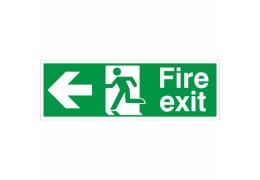
- Fire exit signs with the correct direction of travel (left / right / down) along escape routes
- Final exit identification where people leave the building
- Emergency escape route / safe condition signs where routes could be unclear
- “Fire exit keep clear” where exits could be obstructed
Practical tip: Put exit signs at decision points (doors, corridor junctions, stairwells). If the route could be used in low light (power failure, smoke, night shift), consider photoluminescent (glow-in-the-dark) exit signage.
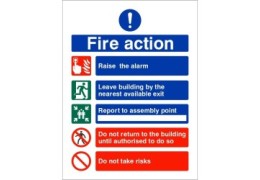
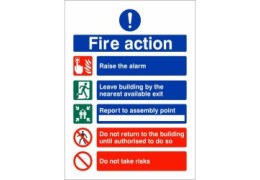
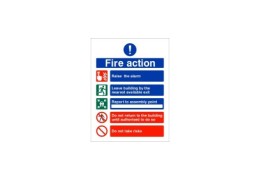
2) Fire action notices (commonly required)
Purpose: to tell occupants what to do if they discover a fire or hear the alarm.
You will often need a Fire Action notice that covers:
- How to raise the alarm
- Evacuation instructions (including any “do not use lifts” instruction where relevant)
- Assembly point location (or how it will be communicated)
- Who to contact / what to do once outside
Placement: near call points, entrances, and other prominent locations where people will see it quickly.
3) Fire alarm call point signs (where needed)
Purpose: to help people locate manual call points fast.
Depending on your layout and visibility, you may need signs such as:
- “Fire alarm call point”
- “Break glass” indicator signage (where appropriate)
Practical tip: If call points are already obvious and unobstructed, extra signage may be minimal. If they are recessed, around corners, or in busy areas, signage becomes more important.
4) Fire extinguisher identification signs (often expected)
Purpose: to identify the extinguisher type and intended use.
Where extinguishers are provided, many sites use signs to show:
- Extinguisher type (e.g. CO2, foam, water, powder, wet chemical)
- Location marking so equipment is easy to find and returned after use
Practical tip: Signage is especially helpful in larger buildings, plant rooms, warehouses, and shared areas where equipment can be moved or hidden by stock.
5) Fire door signs (where applicable)
Purpose: to support compartmentation by keeping fire doors used correctly.
Common examples include:
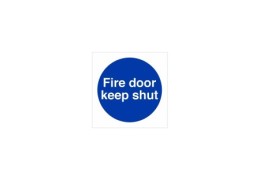
- “Fire door keep shut”
- “Fire door keep locked shut” (where the door must remain locked)
Practical tip: Use the right message for how the door is meant to operate. If a door is on an automatic closer or hold-open device, make sure signage matches the fire strategy for the building.
6) Assembly point signs (where you have a designated muster point)
Purpose: to help people gather safely and support roll calls.
If your fire procedures specify a muster point, an “Assembly point” sign is a simple way to reduce confusion during an evacuation.
What counts as “legally required” in practice?
In most UK buildings, the law requires you to take appropriate fire precautions. Signage becomes “required” when your risk assessment shows that people need clear visual guidance to:
- Find and follow escape routes
- Locate fire alarm equipment and fire-fighting equipment
- Understand emergency instructions quickly
So rather than a single universal list for every building, the legal requirement is to provide the right signs for your premises based on the risks, the layout, and who uses the building (including visitors and contractors).
Common signage mistakes to avoid
- Wrong arrows/directions on exit signs (especially after layout changes)
- Signs hidden behind open doors, racking, or displays
- Inconsistent messages (mixing different styles/wording across the site)
- Faded or damaged signs that are no longer clear
- Missing signs at decision points (junctions, stairwells, final exits)
Quick 10-minute check you can do today
- Walk the main escape routes from typical work areas to the final exits.
- Check every junction has a clear exit direction sign where a choice is made.
- Confirm fire doors have the correct instruction signs.
- Make sure fire action notices are visible and up to date.
- Confirm extinguishers and call points are easy to locate and (where needed) clearly signed.
Need help choosing the right fire safety signs?
If you tell us your building type (office, warehouse, shop, school, etc.) and a rough layout (single floor vs multi-storey, number of exits, any high-risk areas), we can suggest a sensible “minimum recommended” fire safety sign pack based on typical UK setups and your risk assessment outputs.

Latest comments