
Photoluminescent wayfinding signs help people navigate buildings safely, particularly during emergencies or power failures. By absorbing natural or artificial light and glowing in darkness, these signs remain visible when normal lighting is reduced, helping occupants find escape routes, stairways and emergency exits.

Fire Door Signage: Which Signs Do You Need and Where Do They Go?
Fire doors are a key part of a building’s fire safety strategy. They’re designed to slow the spread of fire and smoke, protect escape routes, and buy time for evacuation. But even a correctly installed fire door can fail to do its job if people use it incorrectly — which is where clear, consistent fire door signage helps.
Disclaimer: This article is practical guidance, not legal advice. The exact signage you need depends on your building, your fire risk assessment, and the door’s role (e.g. escape route, plant room, stairwell, riser cupboard).
Why fire door signage matters
Most fire door signs exist to support one simple outcome: the door must be in the right position (shut, or locked shut) at the right time to maintain fire compartmentation.
- “Keep shut” signs help prevent doors being wedged open.
- “Keep locked shut” signs help prevent unauthorised access and ensure the door stays closed.
- Instructional signs (where used) reduce misuse, especially in shared buildings with visitors and contractors.
The main fire door signs (and what they mean)
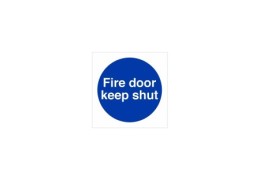
1) “Fire door keep shut”
Use when: the door is normally used, but it must not be left open (common on corridors, stairwells, and escape routes).
Purpose: to remind people the door should be closed after use to maintain compartmentation.
2) “Fire door keep locked shut”
Use when: the door is not intended for general access and should remain locked (common for plant rooms, electrical cupboards, risers, storerooms, and some back-of-house areas).
Purpose: to keep the door closed and prevent unauthorised entry.
3) “Automatic fire door keep clear” (where relevant)
Use when: the door is on an automatic closer or hold-open device and needs space to close fully.
Purpose: to stop stock, bins, or furniture blocking the door’s closing path.
4) “Fire door” identification (where used)
Some sites also use a simple “Fire door” sign to identify the door’s function, particularly in public-facing buildings. Whether this is appropriate depends on your signage standard and risk assessment.
Where do fire door signs go?
In most cases, fire door signs should be placed at eye level on the door itself, where they are clearly visible as someone approaches and uses the door.
Typical placement rules (practical)
- Place the sign on the face of the door that people most commonly use.
- If the door is used from both sides (e.g. a corridor door), consider signage on both sides.
- Keep signs unobstructed (not hidden by push bars, kick plates, glazing manifestations, or door furniture).
- Use a size that is readable at normal approach distance (bigger corridors and higher footfall usually benefit from a larger sign).
Eye-level guidance
A common approach is to position the sign around 1.4m–1.6m from floor level (roughly eye height for most adults), but the key is consistency across the site and clear visibility.
Which message should you choose: “keep shut” vs “keep locked shut”?
This depends on how the door is meant to be used in day-to-day operations:
- Keep shut: the door is used regularly, but must be closed after use.
- Keep locked shut: the door should remain locked and is not for general access.
Important: Don’t use “keep locked shut” on doors that people need to pass through routinely, especially if it could confuse occupants during normal use or emergency procedures. Your fire risk assessment and building fire strategy should guide this.
Common fire door signage mistakes to avoid
- Missing signs on key doors along escape routes (people wedge them open “just for a minute”).
- Wrong sign message (e.g. “keep locked shut” on a door that is used constantly).
- Inconsistent signage across the building (different styles and wording in different areas).
- Poor placement (too low, too high, or hidden behind door furniture).
- Signage used as a substitute for fixing the real issue (e.g. a door that doesn’t latch, a closer that’s too strong, or a door that’s frequently wedged due to heat/noise complaints).
Quick checklist: fire door signage walk-round
- Identify all fire doors on escape routes, stairwells, and compartment lines.
- Confirm each door has the correct sign message (“keep shut” or “keep locked shut”).
- Check signs are visible from the approach direction (and both sides where needed).
- Make sure signs are not damaged, faded, or peeling.
- Look for patterns: if doors are regularly wedged open, consider operational fixes (ventilation, hold-open devices that release on alarm, layout changes) alongside signage.
Need help standardising your fire door signage?
If you tell us what type of building you manage (office, warehouse, school, care setting, retail, etc.) and roughly how many fire doors you have, we can suggest a simple, consistent fire door signage set and typical placement approach to support your fire risk assessment.

Latest comments